Book Review: Why Does He Do That?
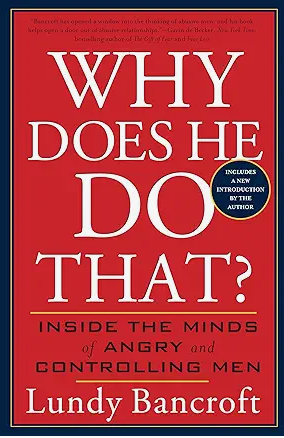
Why Does He Doe That? Inside the Minds of Angry and Controlling Men - By: Lundy Bancroft
Controlling and abusive relationships can be confusing, especially when the harmful behavior is mixed with affection, apologies, and “good seasons.” Many women find themselves asking: Is it really abuse? Why is this happening? Could I fix it if I tried harder?
In Why Does He Do That?, Lundy Bancroft draws on years of work with abusive and controlling men to help readers name patterns clearly, understand the beliefs that drive abusive behavior, and make wiser decisions about safety and next steps.
What Emotional, Verbal, and Physical Abuse Look Like
1.) It’s not “just anger” - it’s about control
A key takeaway is that abuse is often selective and strategic (e.g., how the person behaves in public vs. private), and it’s driven by beliefs like I’m entitled to get my way, my partner owes me, and I get to define reality. While it is often said that people can’t control their anger, Lundy makes a clear argument against this belief.
2.) Early warning signs that show up before things are “obviously abusive.”
Fast intensity/pressure: rushing commitment, pushing exclusivity, ignoring your pacing (“If you loved me you would…”).
Early jealousy framed as love: resentment about your friends, coworkers, family, or time away.
Boundary testing: guilt, sulking, anger, or “punishment” when you say no.
Subtle isolation: discouraging relationships, creating conflict with people who support you.
Your reality being questioned: “You’re too sensitive,” “That never happened,” “You’re crazy,” especially when you bring up harm (early gaslighting).
“Public saint, private critic”: charming and respectable in public, cutting or demeaning in private.
3.) Repeated Negative Patterns
Controlling your world. Your freedom shrinks over time. This happens when they control who you see, where you go, what you wear, and how you spend time. When they monitor your phone/socials/location; needing constant access or “proof” of where you are and what you are doing. Finally, creating consequences for independence (rage, silent treatment, accusations, withholding money/affection)
Controlling your reality. They set the narrative and rewrite history. This is part of why victims feel constantly confused or exhausted. This looks like denial, minimizing, and reframing: “It wasn’t that bad,” “You made me do it,” “You’re remembering wrong.” It often involves blame shifting: every conflict becomes your fault. And deeply demoralizing moving goalposts: the rules change; you can’t win.
Emotional punishment and manipulation. Not all intimidation is physical. It can look like: Slamming doors, breaking objects, driving dangerously, looming, blocking exits. It often involves threats (explicit or implied): “You’ll regret it,” “I’ll ruin you,” “No one will believe you.” Another form of manipulation is “weaponized silence”: prolonged stonewalling meant to make you comply.
Isolation and social sabotage. This looks like starting fights right before you see friends/family. Making you “pay” afterward for going and turning supporters into enemies (“They’re against us / against me”).
Financial control. Taking your income, restricting access to accounts, demanding receipts, and keeping you dependent (blocking work/school, sabotaging childcare/transportation).
Sexual coercion and entitlement. Pressure, guilt, retaliation, or religious manipulation around sex. Framing your “no” as betrayal or disrespect (You don’t have to label this perfectly for it to matter.)
Using children as leverage. Some abusers exploit parenting and children’s emotions to control the other parent by creating loyalty binds, undermining, or “double binds” where mom is blamed either way.
4) The “it’s getting worse” escalation signals
It’s important to pay attention if it feels the temperature is rising, tension is increasing, and you are becoming more worried. Here are some of the typical signs to look for:
More frequent intimidation or threats
Increased monitoring or isolation
Any choking/strangulation history, stalking behaviors, or threats about weapons
Escalation during pregnancy, separation, or after you assert boundaries.
Note: Danger can rise around leaving/separating.
A Quick Assessment - It could be abuse….
Do you feel you’re walking on eggshells?
Do you find yourself editing your life to avoid reactions?
Are you increasingly isolated from support?
Do disagreements end with you feeling afraid, small, or to blame?
Does your partner’s behavior make your world narrower over time?
What to Do With This Information
Talk to someone safe (a trusted friend, advocate, or counselor).
Document what’s happening in a secure way if you’re able.
Refer to our Safety Support
Get expert support